1. Call Forward
1.Call Origination refers to a call initiated from the PSTN or cell phone network is terminated using VoIP.
2.Call Termination refers to a call initiated as a VoIP call is terminated using PSTN or cell phone network.
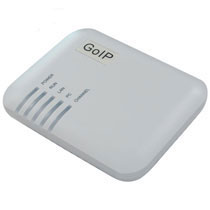
3.As shown in the network topology diagram, a VoIP Service Provider is using GoIPs as call origination and termination devices.
- A call dialed to a GoIP (right hand side) via GSM is first routed via VoIP and then terminated via a VoIP end point or VoIP Service Provider.
- A VoIP call originated from the left hand side is routed to a GoIP on the right hand side and then is dialed out as a GSM call.

2. IP PBX Call Origination and Termination
1.Instead of FXO gateways, GoIP are as a call termination and origination device for the IP PBX as shown in the diagram above.
2.VoIP endpoints connected to the IP PBX can make calls to cellular/traditional telephone network via the GoIP GSM ports.
3.Outside callers can then call in via the GoIP GSM ports to reach any of the VoIP endpoints that are registered to the IP PBX.
4.GoIP can be configured in a group mode such that all GSM ports can be used by just dialing only one GSM number. Please refer to the Call Center Application for more information.

3. Sending Bulk SMS Service
1.Sending bulk sms text messages is a common technique for telemarketing to reach the target customers.
2.A bulk SMS system can be implemented quickly and easily using GoIPs and our proprietary SMS server. Telemarketers are now have full control on how and when they want to send text messages.
3.In addition, SMS text messages are now used widely in many companies, organizations, schools, clubs as a mean for broadcasting information. They can now build their own SMS system without paying expensive charges to their GSM server provider.
4.This system can also take the advantage of using the same GSM service provider to send sms to the phone subscribers in the same service provider.

4. Call Back
1,Call Back is referring to the telecommunications event that occurs when the originator of a call is immediately called back in a second call as a response.
2,GoIP could be used to achieve this function alone or as an terminal that is integrated in an existing call back server / platform. 3,For standalone operation, GoIP receives a call with caller ID information and then rejects the call immediately without answering the call. GoIP then calls back the caller so that he can dial a phone number to make a call. In this case, GoIP must register to a VoIP Service Provider who can offer terminate the call.
4,In a call back system, GoIP acts as a device to initiate the call back function. Typically, this is done in two ways. The first method is to send an SMS with the callee’s phone number to the GoIP. The GoIP then sends both the caller’s and callee’s phone numbers to the call back server to complete the call back function. The second method is to call the GoIP and the hang up (with the call being answered). GoIP sends the caller’s phone number to the call back server and the call back server calls the caller directly so that the caller can then dial a phone number to make a call.